
Key Takeaways
- An 18-wheeler loaded to federal limits can weigh close to 80,000 pounds. That difference alone explains a lot of why truck accident injuries tend to be worse than what shows up in an ordinary car crash.
- Electronic logging device data and dash-cam footage often decide these cases, but the trucking company controls both, and neither one sticks around for long once a crash happens.
- More often than not, the real party on the other side of a truck accident claim isn’t the driver. It’s the trucking company, and it’s usually the one holding the biggest insurance policy.
- Talking to an insurance adjuster on the record before an attorney gets involved is one of the easiest ways to hurt an otherwise strong claim, and people do it more often than they should.
- Texas generally allows two years from the date of a crash for an injured person to get a lawsuit filed.
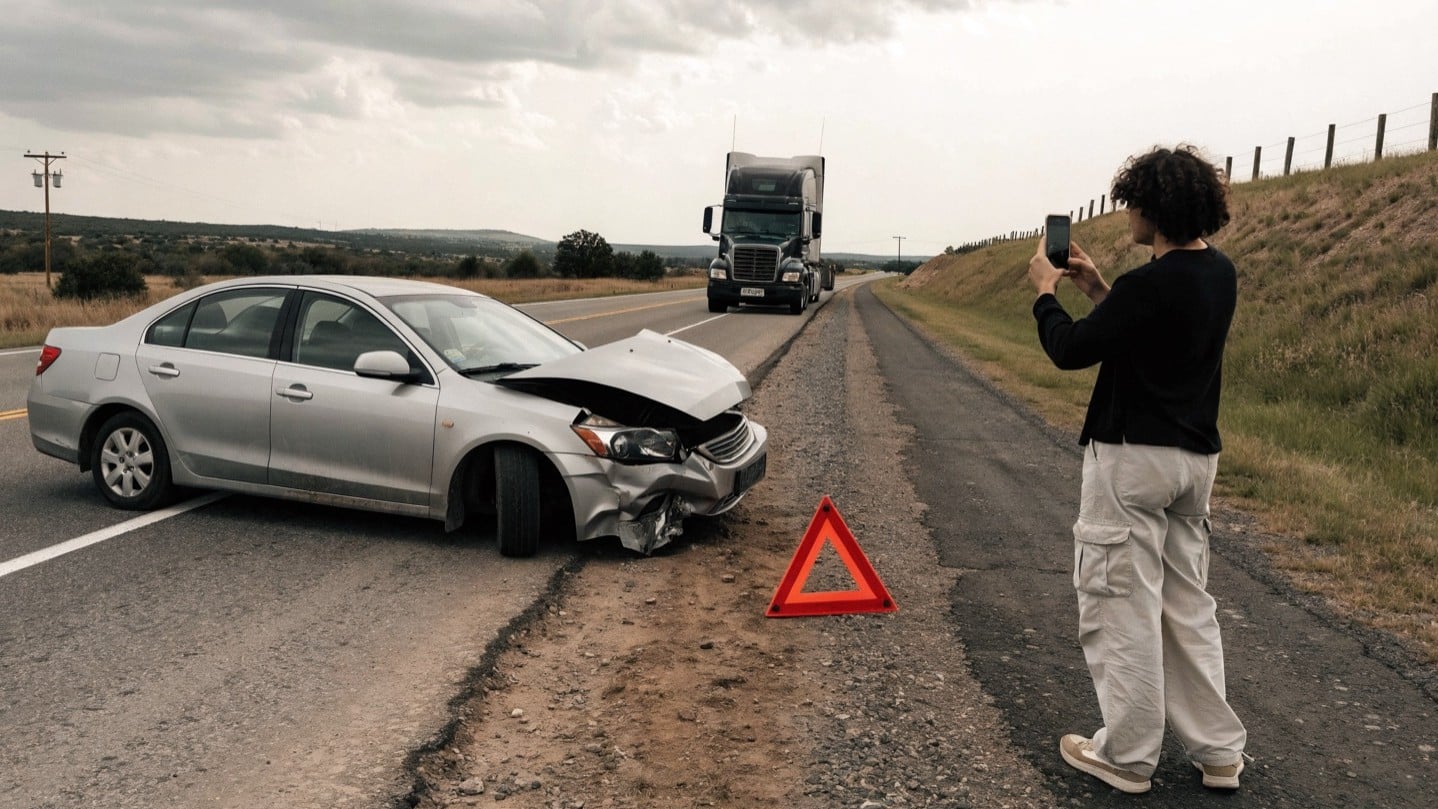
Most people already know the basic steps after a fender-bender, like exchanging information and calling the police. A commercial truck accident works differently in a lot of ways that aren’t always obvious at first, and knowing what to do after a truck accident can be the difference between a strong claim and one that loses leverage before it even gets started.
The Size Difference Changes Everything
A fully loaded 18-wheeler can weigh up to 80,000 pounds under federal weight limits, while a typical sedan weighs only a small fraction of that amount. This size gap is a big part of why truck accident injuries tend to be so much more severe, and it also affects how the trucking company reacts once a crash happens. Legal and insurance teams are sometimes already working on a case before the injured person has even left the hospital.
Evidence Doesn’t Wait
A car accident case usually comes down to who said what and who was where. A truck accident case comes down to paperwork the injured person never gets to see unless someone goes looking for it. Most commercial trucks run electronic logging devices now, and those devices track driving hours closely enough to show whether a driver was fatigued or past a legal limit when a crash happened. Some trucks also carry dash cameras, and fleets keep maintenance files that can say whether a known problem with the truck ever got fixed.
The catch is that a trucking company doesn’t have to hold onto any of this forever. Duty-status records only need to be kept for a set window, and plenty of fleets record over dash-cam footage within days of it being captured. If nobody asks for it in time, it’s simply gone, and there’s rarely a way to get it back afterward. That’s the reason attorneys move fast to send what’s sometimes called a spoliation letter, a formal notice telling the carrier it now has a legal duty to hold onto specific records instead of letting them disappear on the usual schedule.
Why the Trucking Company Is Often the Real Party in Interest
A lot of people assume they’re dealing with an individual driver after a truck accident, when in reality the trucking company is usually the more important party. Under Texas law, an employer can generally be held responsible for a driver’s negligence if that driver was on duty and following a dispatched route at the time of the crash. This isn’t an unusual or hidden legal rule. It’s a long-standing principle meant to make sure injured people aren’t stuck trying to recover money from a driver who may not have the resources to pay a claim. Anyone researching truck accident representation will find this distinction comes up in nearly every serious case.
Trucking companies can also be found negligent in ways that have nothing to do with the driver’s actions behind the wheel. Hiring a driver with a poor safety history, or pressuring drivers to skip required rest periods to meet a delivery schedule, are both examples of decisions that can create liability for the company itself. Most interstate freight carriers are required by federal law to carry at least $750,000 in liability insurance, which usually represents the largest and most immediate source of compensation in a serious truck accident, well beyond what a typical car insurance policy would provide.
Federal Hours-of-Service Rules and Why They Matter
Commercial truck drivers are subject to federal rules limiting how long they can drive without rest, rules that don’t apply to drivers of ordinary passenger vehicles. In general terms, there are limits on how many hours a driver can spend behind the wheel after a rest period, a cap on the total time a driver can remain on duty, and a required break after several consecutive hours of driving. When a driver exceeds these limits in order to make a delivery deadline, that isn’t simply a violation of company policy. It can become important evidence of negligence if a crash occurs. Because electronic logging devices are now standard on most commercial trucks, this kind of data is often available, as long as it’s requested before a carrier’s normal retention period expires.
The Mistakes That Are Easy to Make
A number of decisions made in the days right after a truck accident can weaken a claim more than people realize at the time. Talking to the trucking company’s insurance adjuster on the record before speaking with an attorney is one example. Accepting an early settlement offer before anyone knows the full extent of an injury is another. Posting about the crash on social media can also come back to haunt a claim, since an insurance company may point to a photo or comment as proof the injury wasn’t as serious as claimed. Even putting off a doctor’s visit can hurt a case, because the resulting gap in treatment gives an insurer something to point to later.
Each of these mistakes is understandable given the circumstances, but insurance adjusters are trained to look for exactly these kinds of openings, and a seemingly small misstep early on can have a larger effect on a claim than most people expect.
Why Timing Matters Beyond the Evidence
Texas law generally allows injury victims two years from the date of a crash to file a personal injury lawsuit, and that deadline applies regardless of how complicated the underlying case may be. Insurance companies are aware of this timeline as well, and a company that knows an injured person’s filing deadline is approaching may have less incentive to negotiate fairly. Getting legal advice early isn’t only about avoiding a missed deadline. It also helps preserve negotiating leverage that can otherwise erode over time.
Texas also follows a modified comparative fault system, meaning an injured person’s compensation can be reduced by their own percentage of fault in the crash, and eliminated entirely if they’re found to be more than half responsible. Because insurance companies often have an incentive to shift blame toward the injured party in order to reduce what they owe, a thorough and timely investigation into what actually caused the crash can be just as important as the medical evidence in the case.
What Happens After You Contact a Lawyer
Most truck accident claims never make it in front of a jury. An attorney usually starts by sending out preservation letters so the ELD data and dash-cam footage and maintenance history don’t quietly disappear while everyone’s still piecing together what happened, and from there negotiation begins directly with the carrier’s insurer. A lot of cases get resolved at that stage without anyone ever setting foot in a courtroom.
When negotiations stall instead, the case moves into a lawsuit, and that process tends to follow a fairly predictable rhythm. Someone files a petition to get things started, after which both sides spend a stretch of time exchanging evidence with each other, a phase usually called discovery. Most cases go through mediation at some point before anyone seriously discusses a trial date, and only a small number ever actually get in front of a jury. Just having a lawsuit as a real option, even before it’s filed, tends to keep an insurance company negotiating more honestly than it might otherwise.
What Compensation Can Cover
Compensation in a truck accident case generally falls into two broad categories. Economic damages cover measurable costs such as emergency treatment, hospital stays, ongoing medical care, and wages lost during recovery. Non-economic damages account for harder-to-quantify losses like pain and suffering. Because more than one insurance policy is often involved in a truck accident, including policies covering the driver, the carrier, and sometimes a separate maintenance or cargo company, the total compensation available can be considerably higher than what a typical vehicle accident claim might offer, though the actual value of any case depends entirely on its specific facts.
If a Loved One Didn’t Survive the Crash
In cases where a truck accident results in a death rather than an injury, Texas’s Wrongful Death Act allows certain surviving family members to bring a claim on behalf of their loved one. The same urgency around preserving evidence applies in these situations as well, since records like ELD data, dispatch logs, and maintenance history are just as time-sensitive in a fatal crash investigation as they are in a case involving an injury.
Why Bilingual Representation Matters in These Cases
Truck accidents affect people from a wide range of backgrounds, and language shouldn’t stand between someone and a clear understanding of their own legal situation. A firm where an attorney can communicate directly with a client in their own language, rather than relying on a translated form after the fact, can make a meaningful difference in how well a family understands what’s happening during an already difficult time.
What a Thorough First Step Looks Like
The period immediately following a truck accident can be overwhelming. Getting medical care comes first, even when an injury doesn’t feel serious in the moment. Documenting whatever can reasonably be documented helps too, and it’s worth avoiding any conversation with the trucking company’s insurer until there’s been a chance to talk to a lawyer. Starting the evidence preservation process quickly matters more than most people expect, for the reasons already covered above. Truck accident claims are also typically handled on a contingency basis, so there’s no attorney’s fee unless money is actually recovered, and that removes cost as a reason to delay getting a case evaluated. More about the firm’s approach is available on its About page.
The León Law Firm, P.C.
1 Sugar Creek Center Boulevard
Sugar Land
TX
77478
United States


