
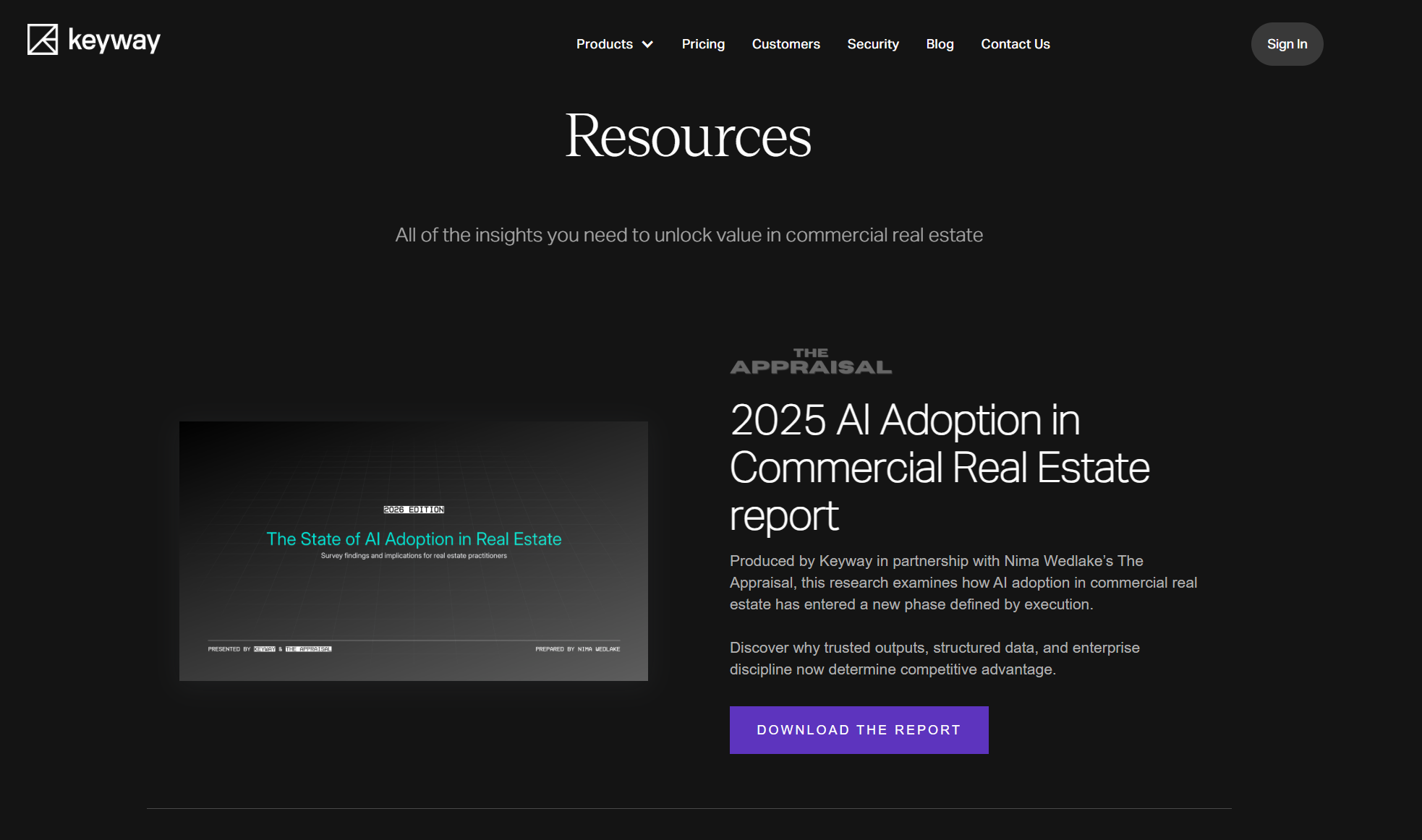
AI is widely tested in commercial real estate, but real deployment remains limited by trust gaps, data challenges, and system integration issues.
NEW YORK CITY, NY, UNITED STATES, February 23, 2026 /EINPresswire.com/ — According to the State of AI Adoption in Real Estate Survey, conducted by Keyway in partnership with The Appraisal, the industry is now firmly in an expansion phase marked by widespread pilots, rapidly growing budgets, and persistent structural barriers to full-scale deployment.
The study surveyed 150 U.S.-based real estate professionals across property management, asset management, finance, acquisitions, and general management. While the majority of firms now report some level of AI usage, only a small fraction have successfully moved from experimentation to enterprise-wide production.
The “Pilot Paradox”: Experimentation Is High, Deployment Is Not
One of the most striking findings of the report is what researchers describe as the “pilot paradox.” While 45% of firms are currently running AI pilots, only 9% have achieved enterprise-wide AI deployment. Even more critically, just 8% of firms consider their data infrastructure fully ready for AI at scale.
This disconnect suggests that while interest in AI is strong, most organizations remain constrained by fragmented systems, inconsistent data standards, and limited internal readiness. As a result, many firms are accumulating sunk costs in pilots without capturing the full return on AI investment.
Trust Emerges as a Major Barrier to Financial AI Use
Despite growing adoption, trust remains one of the most significant barriers—particularly in high-stakes financial use cases such as underwriting and valuation. The survey found that:
• 44% of respondents say their investment committees distrust AI-generated analysis
• Only 27% express any level of trust in AI for financial decision-making
• Top concerns include hallucinations and unreliable outputs (41%), system integration challenges (33%), and data privacy risks
These findings indicate that while AI is increasingly accepted for operational efficiency, its penetration into core investment workflows remains limited by credibility concerns.
AI Is Being Used as a Co-Pilot—Not a Workforce Replacement
The report also signals a clear consensus on how AI is being positioned inside organizations. Rather than driving workforce reduction, AI is overwhelmingly being used to enhance productivity:
• 91% of firms cite efficiency as their primary AI use case
• Only 18% plan any form of headcount reduction
• Over the next five years, most respondents expect AI to automate manual tasks and improve investment decisions—but not to significantly shrink teams
This confirms that the prevailing adoption model in real estate is augmentation, not automation.
AI Spending Accelerates Rapidly
AI is now becoming a core budget priority. The survey shows that:
• More than 50% of firms plan to increase AI spending by over 20% in the next 24 months
• 58% expect to purchase new AI software within the next 12 months
This shift signals that AI has moved from experimental technology to long-term strategic infrastructure within the industry.
Multifamily Emerges as the Largest Untapped Opportunity
AI adoption varies significantly by asset class. Student housing currently leads enterprise AI deployment at 16%, while office shows the highest level of active AI experimentation. However, multifamily—despite being the largest asset class—shows the lowest enterprise-level adoption.
This positions multifamily as the largest untapped vertical for AI-driven transformation, particularly across underwriting, rent comps, asset management, and risk analytics.
Data Readiness Is the Structural Bottleneck
Perhaps the most critical constraint uncovered by the study is data infrastructure. More than three-quarters of firms report significant data readiness gaps, with only 8% reporting full AI readiness. Fragmented property systems, lack of data standardization, and incomplete historical records continue to limit AI’s effectiveness at scale.
This suggests that AI success in real estate will be driven less by tool adoption and more by data modernization strategies.
Industry Outlook: From Experimentation to Execution
The survey confirms that real estate is entering its AI execution phase. The early experimentation wave is giving way to a more disciplined focus on integration, ROI, and enterprise deployment.
Over the next two years, AI is expected to reshape how quickly deals are evaluated, how risk is quantified, how assets are priced and how portfolios are managed at scale.
The winners, the survey suggests, will not be those who merely adopt AI—but those who operationalize it with trust, data integrity, and enterprise discipline
Download the full Report to learn more about the insights and findings of this study here https://www.keyway.ai/blog
Felisa Blaquier
Keyway
felisa@keyway.ai
Visit us on social media:
LinkedIn
Legal Disclaimer:
EIN Presswire provides this news content “as is” without warranty of any kind. We do not accept any responsibility or liability
for the accuracy, content, images, videos, licenses, completeness, legality, or reliability of the information contained in this
article. If you have any complaints or copyright issues related to this article, kindly contact the author above.