
Rising ESD sensitivity across electronics, e-commerce logistics, automated manufacturing accelerates global adoption of engineered antistatic coating systems
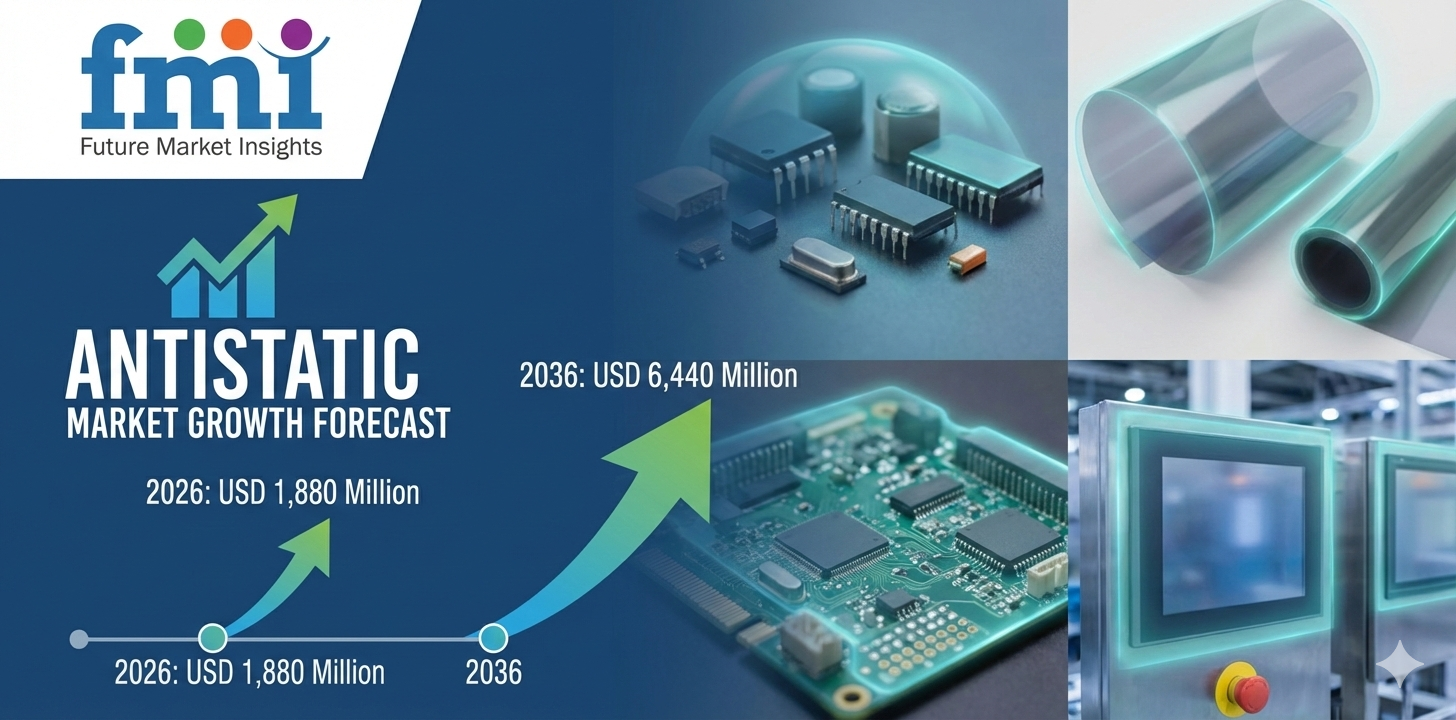
NEWARK, DE, UNITED STATES, February 18, 2026 /EINPresswire.com/ — The global Antistatic Coating Market is valued at USD 1,880 million in 2026 and is projected to reach USD 6,440 million by 2036, expanding at a CAGR of 13.1% from 2026 to 2036. Growth is driven by electronics miniaturization, rapid e-commerce infrastructure build-out, industrial automation, and tightening ESD compliance standards across global manufacturing supply chains.
As electrostatic discharge (ESD) shifts from a quality concern to a yield-critical risk, antistatic coatings are evolving from commodity surface treatments into application-engineered protection systems—becoming a strategic input for electronics packaging, industrial equipment, display surfaces, and technical textiles.
Antistatic Coating Market Snapshot (2026–2036)
• Market size in 2026: USD 1,880 million
• Market size in 2036: USD 6,440 million
• CAGR (2026–2036): ~13.1%
• Leading coating technology: Conductive coatings
• Top application segment: Electronics packaging
• Dominant base material: PET films
• Fastest-growing country: India
• Key companies: Global material science and specialty coating leaders
Market Momentum
The Antistatic Coating Market begins at USD 1.88 billion in 2026, supported by accelerating electronics production and formalization of ESD control programs across manufacturing environments. By 2028–2030, expanded semiconductor capacity, automated logistics networks, and stricter supplier qualification protocols significantly lift demand for permanent, humidity-independent antistatic coatings.
Entering 2032 and beyond, sustainability mandates, multifunctional coating integration, and regional manufacturing localization reinforce adoption. By 2036, the market reaches USD 6.44 billion, maintaining strong momentum as antistatic coatings become embedded within standardized electronics packaging, industrial automation, and advanced materials workflows.
Request For Sample Report | Customize Report |purchase Full Report – https://www.futuremarketinsights.com/reports/sample/rep-gb-32067
Why the Market is Growing
The Antistatic Coating Market is expanding as manufacturers confront rising ESD risks stemming from miniaturized electronics, high-speed automation, and globalized logistics. Approximately 30% of electronic component failures are attributed to ESD events, pushing electronics OEMs and packaging converters to institutionalize validated antistatic coating systems.
Electronics packaging remains the primary demand driver, as every semiconductor wafer, PCB, and finished device requires protection during fabrication, assembly, transport, and storage. At the same time, e-commerce fulfillment networks generate substantial triboelectric charging through automated handling, accelerating adoption of antistatic-coated films, liners, and protective packaging.
Beyond electronics, Industry 4.0 investments are amplifying demand for antistatic coatings on equipment housings, work surfaces, trays, and flooring to suppress charge accumulation across robotic production lines.
Rather than serving as optional enhancements, antistatic coatings are now evaluated as engineered materials delivering controlled surface resistivity, abrasion durability, and substrate compatibility across extended operational lifecycles.
Segment Spotlight
1. Application: Electronics Packaging Leads Demand
Electronics packaging accounts for approximately 48% of total market demand. Antistatic coatings applied to carrier tapes, tray liners, reel covers, and shipping materials provide the first line of defense against ESD throughout semiconductor and electronics supply chains.
2. Coating Technology: Conductive Coatings Dominate
Conductive coatings represent nearly 50% of technology demand, driven by their permanent antistatic performance, low humidity dependence, and resistance to abrasion and environmental aging—making them essential for industrial, automotive, and aerospace applications.
3. Base Material: PET Films Remain Core Substrates
PET films account for roughly 52% of base material usage due to their optical clarity, dimensional stability, mechanical strength, and superior adhesion with conductive polymer systems.
Country Growth Outlook (2026–2036)
India leads growth at a projected 15.8% CAGR, propelled by electronics manufacturing localization and rapid industrialization. China follows at 14.6% CAGR, supported by semiconductor capacity expansion and EV production scale. The United States retains a strong 13.0% CAGR, driven by domestic fab construction and defense electronics requirements. Germany advances at 12.2% CAGR through automotive electronics ESD mandates, while Japan grows at 10.0% CAGR, shaped by its mature semiconductor materials ecosystem and high-performance film innovations.
Competitive Landscape
The market features global material science companies and specialty coating suppliers competing on conductive formulation expertise, substrate-specific adhesion engineering, and sustainability documentation.
Major participants such as 3M, BASF, Toray Industries, and AkzoNobel continue investing in conductive polymer technologies, high-durability coating systems, and environmentally compliant formulations to meet increasingly stringent electronics and industrial specifications.
Competition increasingly centers on permanent antistatic performance, batch consistency, OEM qualification depth, sustainability credentials, and the ability to support application-engineered coating solutions across global manufacturing footprints.
Frequently Asked Questions (FAQ)
What is the global Antistatic Coating Market size?
The market is valued at approximately USD 1,880 million in 2026 and is projected to reach USD 6,440 million by 2036.
At what rate is the market expected to grow?
The market is forecast to expand at a CAGR of about 13.1% from 2026 to 2036.
What are antistatic coatings?
They are engineered coating systems designed to control surface resistivity and static decay, preventing electrostatic discharge and enabling safe handling of ESD-sensitive devices and materials.
Why are antistatic coatings gaining importance?
They help manufacturers reduce ESD-related failures, protect high-value electronics, support automated production environments, and comply with increasingly strict global ESD standards—while maintaining durability and optical performance where required.
Explore More Related Studies Published by FMI Research:
olid Control Equipment Market https://www.futuremarketinsights.com/reports/solid-control-equipment-market
Charging Nitrogen Gas Systems Market https://www.futuremarketinsights.com/reports/charging-nitrogen-gas-systems-market
Non-Invasive Blood Glucose Monitoring Devices Market https://www.futuremarketinsights.com/reports/non-invasive-blood-glucose-monitoring-devices-market
About Future Market Insights (FMI)
Fture Market Insights, Inc. (FMI) is an ESOMAR-certified, ISO 9001:2015 market research and consulting organization, trusted by Fortune 500 clients and global enterprises. With operations in the U.S., UK, India, and Dubai, FMI provides data-backed insights and strategic intelligence across 30+ industries and 1200 markets worldwide.
Why Choose FMI: https://www.futuremarketinsights.com/why-fmi
Sudip Saha
Future Market Insights Inc.
+1 347-918-3531
rahul.singh@futuremarketinsights.com
Legal Disclaimer:
EIN Presswire provides this news content “as is” without warranty of any kind. We do not accept any responsibility or liability
for the accuracy, content, images, videos, licenses, completeness, legality, or reliability of the information contained in this
article. If you have any complaints or copyright issues related to this article, kindly contact the author above.