
Steve Russell // Toronto Star via Getty Images
This tech could keep EVs from stressing the grid â and save everyone money
If youâre a typical American, you get home from work and start flipping switches and turning knobs â doing laundry, cooking dinner, watching TV. With so many other folks doing the same, the strain on the electrical grid in residential areas is highest at this time. That demand will only grow as the world moves away from fossil fuels, with more people buying induction stoves, heat pumps, and electric vehicles.
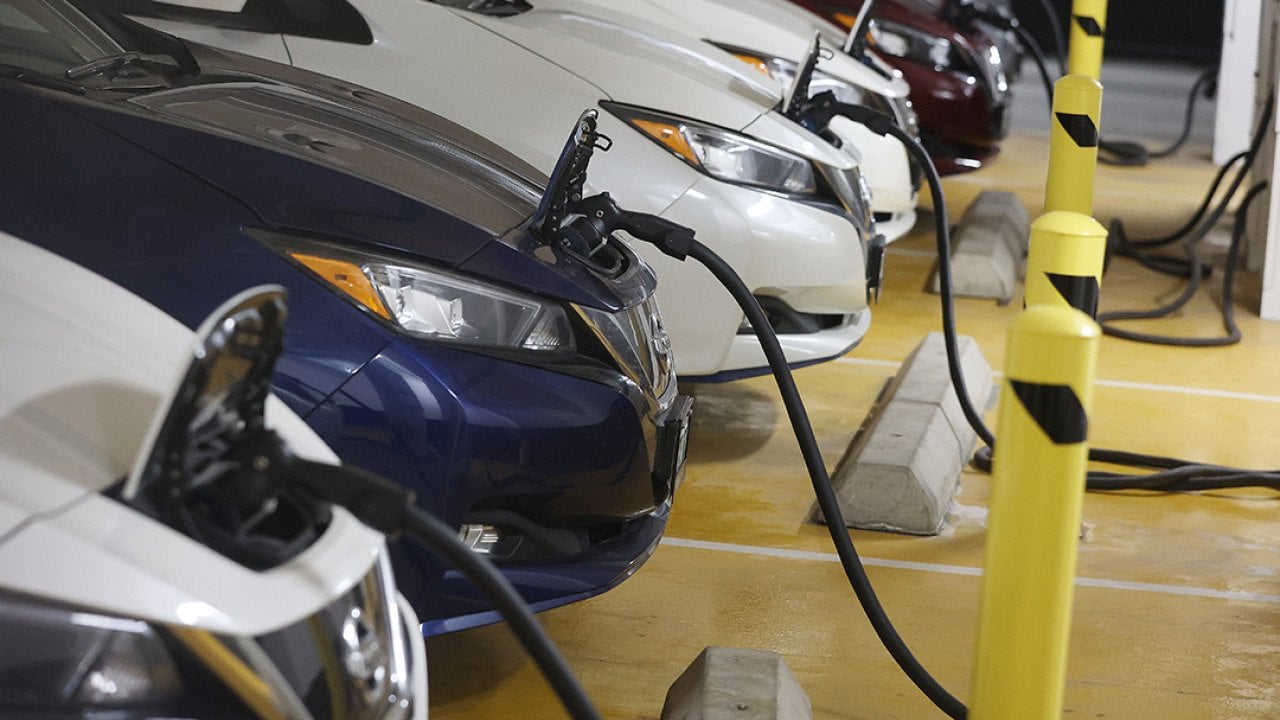
Thatâs a challenge for utilities, which are already managing creaky grids across the United States, all while trying to meet a growing demand for power, Grist reports. So theyâre now trying to turn EVs from a burden into a boon. More and more models, for instance, feature âvehicle-to-grid,â or V2G, capabilities, meaning they can send power to the grid as needed. Others are experimenting with whatâs called active managed charging, in which algorithms stagger when EVs charge, instead of them all drawing energy as soon as their owners plug in. The idea is for some people to charge later, but still have a full battery when they leave for work in the morning.
A new report from the Brattle Group, an economic and energy consultancy, done for EnergyHub, which develops such technology, has used real-world data from EV owners in Washington state to demonstrate the potential of this approach, both for utilities and drivers. They found that an active managed charging program saves up to $400 per EV each year, and the vehicles were still always fully charged in the morning. Utilities, too, seem to benefit, as the redistributed demand results in less of a spike in the early evening. That, in turn, would mean that a utility can delay costly upgrades â which they need in order to accommodate increased electrification â saving ratepayers money.
Active managed charging works in conjunction with something called âtime of use,â in which a utility charges different rates depending on the time of day. Between 4 p.m. and 9 p.m., when demand is high, rates are also high. But after 9 p.m., they fall. EV owners who wait until later in the evening to charge pay less for the same electricity.
Time-of-use pricing discourages energy use when demand is highest, lightening the load and reducing how much electricity utilities need to generate. But thereâs nothing stopping everyone from plugging in as soon as cheaper rates kick in at 9 p.m. As EV adoption grows, that coordination problem can create a new spike in demand. âAn EV can be on its own twice the peak load of a typical home,â said Akhilesh Ramakrishnan, managing energy associate at the Brattle Group. âYou get to the point where they start needing to be managed differently.â
Thatâs where active managed charging comes in. Using an app, an EV owner indicates when they need their car to be charged, and how much charge their battery needs for the day. (The app also learns over time to predict when a vehicle will unplug.) When they get home at 6 p.m., the owner can plug in, but the car wonât begin to charge. Instead, the system waits until some point in the night to turn on the juice, leaving enough time to fully charge the vehicle by the indicated hour. âIf customers donât believe that weâre going to get them there, then theyâre not going to allow us to control their vehicle effectively,â said Freddie Hall, a data scientist at EnergyHub.
The typical driver only goes 30 miles in a day, Hall added, requiring about two hours of charging each night. By actively managing many cars across neighborhoods, the system can more evenly distribute demand throughout the night: Folks will leave for work earlier or later than their neighbors, vehicles with bigger batteries will need more time to charge, and some will be almost empty while others may need to top up.
Theyâre all still getting the lower prices with time of use rates, but theyâre not taxing the grid by all charging at 9 p.m. âThe results are actually very, very promising in terms of reducing the peak loads,â said Jan Kleissl, director of the Center for Energy Research at the University of California, San Diego, who wasnât involved in the report. âIt shows big potential for reducing costs of EV charging in general.â
Active managed charging would allow the grid to accommodate twice the number of EVs before a utility has to start upgrading the system to handle the added load, according to the report. (And consider all the additional demand for energy from things like data centers.) Those costs inevitably get passed down to all ratepayers. But, the report notes, active managed charging could delay those upgrades by up to a decade. âAs EVs grow, if you donât implement these solutions, thereâs going to be a lot more upgrades, and thatâs going to lead to rate impacts for everyone,â Ramakrishnan said.
At the same time, EVs could help reduce those rates in the long term, thanks to V2G, a separate emerging technology. It allows a utility to call on EVs sitting in garages as a vast network of backup power. So when demand surges, those vehicles can send power to the grid for others to use, or just power the house theyâre sitting in, essentially removing the structure from the grid and lowering demand. (And think of all the fleets of electric vehicles, like school buses, with huge batteries to use as additional power.) With all that backup energy, utilities might not need to build as many costly battery facilities of their own, projects that ratepayers wouldnât need to foot the bill for.
Active managed charging and V2G could work in concert, with some batteries draining at 6 pm as they provide energy, then recharging later at night. But that ballet will require more large-scale experimentation. âHow are we going to fit in discharging a battery, as well as charging it overnight?â Hall said. âBecause you do want it available the next day.â
To cut greenhouse gas emissions as quickly as possible, the world needs more EVs. Now itâs just a matter of making them benefit the grid instead of taxing it.
This story was produced by Grist and reviewed and distributed by Stacker.