
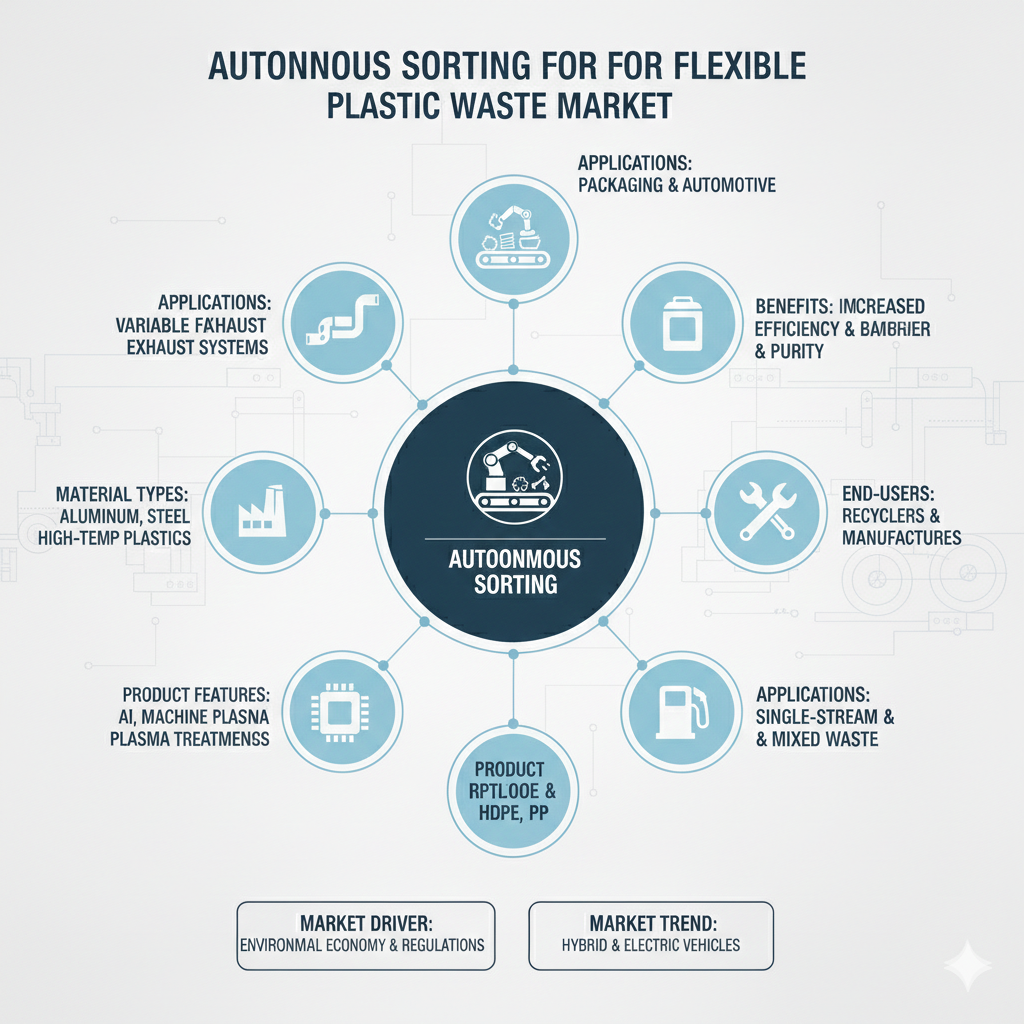
Autonomous sorting for flexible plastic waste market revenue is projected to total USD 1,260 million in 2026, increasing to USD 4,480 million by 2036.
NEWARK, DE, UNITED STATES, February 16, 2026 /EINPresswire.com/ — The global market for autonomous sorting of flexible plastic waste is projected to grow from USD 1,260 million in 2026 to USD 4,480 million by 2036, expanding at a significant 13.5% CAGR.
According to Future Market Insights (FMI), the industry is shifting from standalone robotic pickers to integrated cognitive sorting lines. This transition is fueled by the economic necessity of managing high-volume, low-value film waste—a task traditionally too labor-intensive and error-prone for manual sorting.
Market snapshot: global autonomous sorting of flexible plastic waste market 2026 – 2036
• Market Size (2026): Estimated at USD 1,260 million.
• Market Size (2036): Projected to reach USD 4,480 million.
• CAGR (2026-2036): 13.5%.
• Leading Technology: Vision AI + Robotics accounts for a 55% market share.
• Primary Material Focus: PE and PP films represent over 55% of the material targeted.
• Key Growth Driver: Inefficiency of traditional air classifiers and high labor costs for manual film picking.
• Fastest Growing Market: India leads with a 15.2% CAGR.
• Major Players: TOMRA, Recycleye, AMP Robotics, BHS, and ZenRobotics.
Request For Sample Report | Customize Report | Purchase Full Report
https://www.futuremarketinsights.com/reports/sample/rep-gb-32020
Key Technological Drivers
1. Beyond NIR: Multi-Sensor Fusion
Traditional Near-Infrared (NIR) systems struggle with the variability of crumpled, soiled, or multilayer films. Modern leaders like TOMRA are now using multi-sensor fusion, combining hyperspectral imaging with high-resolution RGB cameras and 3D shape detection to identify materials based on texture, labels, and even dirt patterns.
2. AI-Driven Decision Latency
Innovation is focused on the speed of “cognitive” decisions. AMP Robotics has demonstrated that reducing decision latency allows robots to operate at industrial throughput levels, overcoming the bottleneck where slow manual picking once constrained recycling line efficiency.
3. Robotic End-Effectors (Grippers)
Sorting flexible waste requires specialized “soft-gripper” technology. Unlike rigid containers, films are non-rigid and clingy. The development of advanced pneumatic and vacuum-based end-effectors that can grasp and release thin films without tearing is a critical competitive differentiator.
Competitive Landscape
The market is evolving from equipment sales to a software-as-a-service (SaaS) model. Companies like Recycleye and Bulk Handling Systems (BHS) are embedding AI deeper into quality control, generating “digital twins” of sorted bales. This data allows MRFs to guarantee purity levels to chemical recyclers, securing premium pricing for their output.
Top Companies Profiled:
• TOMRA Systems ASA
• Recycleye Ltd.
• AMP Robotics Corp.
• Bulk Handling Systems (BHS)
• Yaskawa Electric Corporation
• Hikrobot Co., Ltd.
FAQ
How big is the autonomous sorting for flexible plastic waste market in 2026?
The global market is estimated to be valued at USD 1,260 million in 2026, driven by the industrialization of AI-enabled sorting lines.
What is the projected market size by 2036?
The market is expected to reach USD 4,480 million by 2036, representing a significant expansion of nearly 3.5x its 2026 value.
What is the expected growth rate (CAGR) for this market?
The industry is projected to expand at a robust 13.5% CAGR from 2026 to 2036 as MRFs transition toward fully autonomous sorting halls.
Which material segment holds the largest share in this market?
PE/PP films command a dominant 55.0% share, anchored by high waste volumes and mandatory recycled content regulations like the EU’s PPWR.
Which country is leading the global market in terms of growth?
India records the fastest growth at a 15.2% CAGR, fueled by the formalization of waste infrastructure and the adoption of “frugal automation” strategies.
Similar Industry Reports
Household Flexible Plastic Front-of-Store Collection and Sorting Market
https://www.futuremarketinsights.com/reports/household-flexible-plastic-front-of-store-collection-and-sorting-market
Flexible Plastic Packaging Market
https://www.futuremarketinsights.com/reports/flexible-plastic-packaging-market
Flexible Plastic Pouch Market
https://www.futuremarketinsights.com/reports/flexible-plastic-pouch-market
Sudip Saha
Future Market Insights Inc.
+1 347-918-3531
email us here
Legal Disclaimer:
EIN Presswire provides this news content “as is” without warranty of any kind. We do not accept any responsibility or liability
for the accuracy, content, images, videos, licenses, completeness, legality, or reliability of the information contained in this
article. If you have any complaints or copyright issues related to this article, kindly contact the author above.