
Data Center Market Size, Infrastructure Trends, and Growth Forecast 2026–2034
PUNE, MAHARASHTRA, INDIA, February 10, 2026 /EINPresswire.com/ — Market Overview
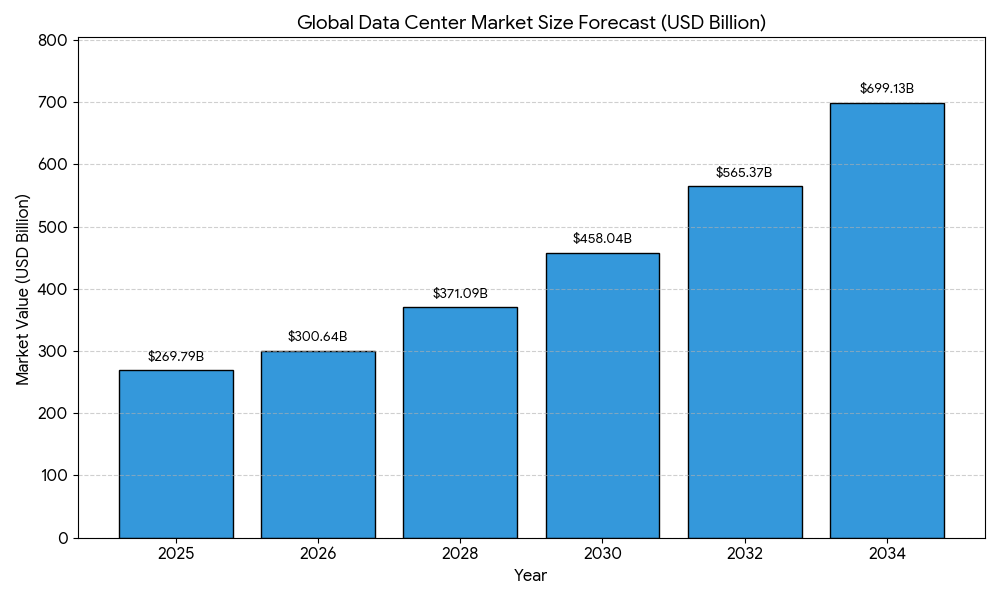
The global data center market size was valued at USD 269.79 billion in 2025 and is projected to grow from USD 300.64 billion in 2026 to USD 699.13 billion by 2034, exhibiting a CAGR of 11.10% during the forecast period. North America dominated the data center market with a market share of 38.50% in 2025.
A data center encompasses an integrated ecosystem of technologies, businesses, and services dedicated to the development, utilization, and operation of data facilities. This comprehensive infrastructure includes hardware components such as servers, storage devices, racks, networking equipment, along with specialized software and services designed to store and distribute digital data. The market landscape remains highly competitive and dynamic, characterized by continuous innovation in facility designs, operational methodologies, and emerging technologies including cloud computing and edge computing solutions.
Request a Sample PDF: https://www.fortunebusinessinsights.com/enquiry/request-sample-pdf/data-center-market-109851
Generative AI Impact
The emergence of generative AI technologies has created new demands for computational infrastructure. Deep learning models require substantial processing resources for both training and inference operations, driving increased need for high-performance computing capabilities. Data centers must now provide robust storage and management solutions to handle the massive datasets required for AI model training.
Generative AI integration enables data centers to achieve higher accuracy, minimal interventions, consistent performance, and predictable outcomes. This technology transformation necessitates scalable infrastructure investments to support increasingly sophisticated artificial intelligence applications.
Market Trends and Growth Drivers
Hybrid and Multi-Cloud Adoption
Organizations increasingly implement hybrid and multi-cloud strategies to leverage benefits across public cloud services, private cloud environments, and on-premise infrastructure. This trend drives demand for interconnection platforms, colocation services, and hybrid cloud management solutions enabling seamless integration, workload mobility, and data portability across diverse cloud environments.
Modular and prefabricated data center solutions gain popularity due to their flexibility, scalability, and rapid deployment capabilities. These pre-engineered modules enable quick assembly and deployment to meet changing capacity requirements while reducing construction costs and timeframes compared to traditional facilities.
Digital Transformation and Cloud Services
Rapid digital transformation across industries fuels data center demand as organizations adopt cloud services for enhanced flexibility, scalability, and cost efficiency. The growth of cloud computing models including private, public, and hybrid clouds significantly boosts data center investments.
The rollout of 5G networks and increasing demand for high-bandwidth, low-latency applications drive edge data center deployment among small and medium businesses. These facilities position computing resources closer to end-users and devices, supporting real-time processing and reducing latency for applications such as smart cities, autonomous vehicles, and augmented reality experiences.
Market Segmentation Analysis
Component Analysis
Hardware components captured the largest market share in 2024, providing foundational infrastructure for reliable, high-performance computing environments. This segment encompasses power systems, cooling systems, servers, networking devices, and supporting equipment. Hardware scalability enables organizations to expand computing resources without significant downtime.
Data Center Infrastructure Management (DCIM) software demonstrates the highest growth potential, offering centralized platforms for managing and monitoring all infrastructure aspects. This software provides enhanced control and visibility, enabling operators to efficiently oversee and coordinate operations.
Data Center Type
Colocation facilities lead the market by offering flexible scalability options and cost-effective solutions. Shared infrastructure resources reduce upfront capital expenditure compared to private facilities, while economies of scale enable competitive pricing for security and connectivity services.
Hyperscale data centers exhibit the highest growth rate, designed to scale rapidly and efficiently to support massive data volumes and workloads. Their architecture enables seamless expansion of computing, storage, and networking resources to accommodate growing demand while maintaining performance and reliability.
Tier Level Classification
Tier 3 data centers captured the largest market share, featuring redundant network connectivity with multiple carriers and internet service providers. This configuration ensures diverse and resilient communication pathways, minimizing network outage risks for mission-critical applications.
Tier 4 facilities demonstrate the highest growth potential, implementing advanced physical security measures including biometric access controls, intrusion detection systems, surveillance cameras, and security protocols. These centers employ comprehensive cybersecurity measures to protect against cyber threats and data breaches.
Request for an enquiry: https://www.fortunebusinessinsights.com/enquiry/book-a-call/data-center-market-109851
Regional Market Dynamics
North America
North America maintains market leadership through rapid adoption of cloud services, artificial intelligence, and big data applications. The surge in generative AI and advanced technologies necessitates enhanced data processing capabilities and robust infrastructure. Substantial investments from major players including Schneider Electric, IBM, and Cisco fuel continued market expansion.
Asia Pacific
Asia Pacific demonstrates the highest growth rate, with total supply projected to increase from 11.1 GW in 2023 to 26.7 GW by 2028. Growing populations and increasing digital demands position countries like Indonesia as key markets. Major investments support hyperscale data center development, particularly in Jakarta and Eastern Java.
Europe
Europe exhibits prominent growth supported by extensive and advanced network infrastructure including widespread fiber optic networks and high-speed internet connectivity. Major data center hubs in Germany, Ireland, and the Netherlands host cutting-edge technologies and high-performance computing capabilities. The region’s central global location attracts substantial investments from both global technology providers and local players.
Market Restraints
Significant initial investments in infrastructure including power and cooling systems, real estate, IT hardware, and network equipment create barriers for small and medium enterprises with limited financial resources. High operational costs for electricity, cooling, security, staffing, and maintenance strain budgets and reduce profitability, particularly for large-scale operations.
Competitive Landscape
Key industry players include Schneider Electric, Cisco Systems, ABB Ltd., Hewlett Packard Enterprise, Dell Technologies, Hitachi Ltd., Huawei Technologies, NTT Communications, Comarch SA, and IBM Corporation. These organizations implement strategic initiatives including facility partnerships, modular solution launches, and new data center developments to meet evolving market demands and maintain competitive advantages.
Get More Research Reports
Data Center Rack Market Size, Share and Growth Analysis
Data Center Automation Market
Ashwin Arora
Fortune Business Insights™ Pvt. Ltd.
+1 833-909-2966
sales@fortunebusinessinsights.com
Legal Disclaimer:
EIN Presswire provides this news content “as is” without warranty of any kind. We do not accept any responsibility or liability
for the accuracy, content, images, videos, licenses, completeness, legality, or reliability of the information contained in this
article. If you have any complaints or copyright issues related to this article, kindly contact the author above.

