Global aero gel creams market to grow at 12.8% CAGR through 2036 as digital replenishment, reformulation mandates, and science-led skincare scale demand.
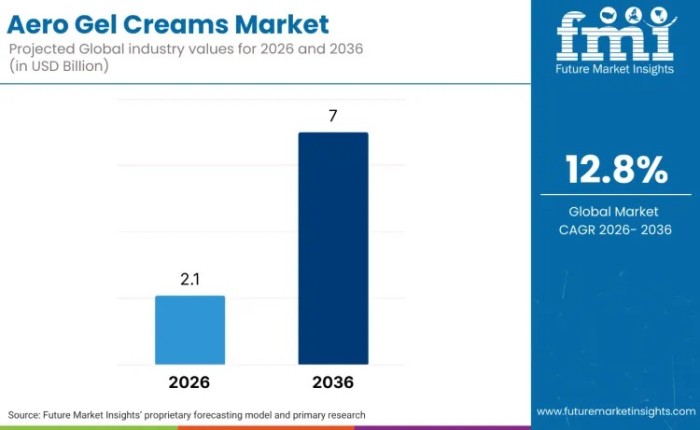
NEWARK, DE, UNITED STATES, February 6, 2026 /EINPresswire.com/ — The global aero gel creams market, valued at USD 2.1 billion in 2026, is projected to experience significant growth, reaching an estimated USD 7.0 billion by 2036. According to the latest analysis by Future Market Insights (FMI), the sector will expand at a compound annual growth rate (CAGR) of 12.80% over the next decade. This growth trajectory reflects evolving consumer preferences, regulatory changes, and strategic industry investments, all converging to redefine the lightweight moisturisation segment within the broader skincare market.
The market’s expansion reflects a structural shift in skincare toward lightweight, fast-absorbing moisturisers that function as daily regimen anchors rather than seasonal products. Portfolio investment, tightening cosmetic governance, and the economics of online replenishment are converging to accelerate adoption across premium and mass-premium segments. As a result, aero gel creams are increasingly positioned at the center of scalable, compliance-ready skincare platforms through 2036.
Request For Sample Report | Customize Report |purchase Full Report – https://www.futuremarketinsights.com/reports/sample/rep-gb-31837
Market Overview:
Aero gel creams are lightweight, fast-absorbing gel-cream moisturisers designed to deliver hydration, cooling, soothing, and barrier-supporting benefits within cosmetic regulatory frameworks. Primarily positioned as daily facial moisturisers for normal to sensitive skin types, these products are sold through online retail, specialty stores, pharmacies, and clinic-adjacent channels worldwide.
Market expansion is driven by portfolio owners who view lightweight moisturisation as a regimen anchor, leveraging digital replenishment systems and clinic recommendation loops to increase consumer adherence and repeat purchases. The significant capital movements in this space are exemplified by L’Oréal Groupe’s 2025 acquisition of a majority stake in Medik8, integrating the science-led skincare brand into its Luxe Division to accelerate global premium gel texture rollouts.
Key Market Drivers and Industry Dynamics
The aero gel creams market growth is underpinned by several key factors:
Regulatory Influence: The European Union’s Commission Regulation (EU) 2024/1328 extends REACH Annex XVII restrictions on cyclic siloxanes (D4, D5, D6) across consumer and professional cosmetic uses, including leave-on products. This legislative change compels manufacturers to reformulate silicone-heavy gel textures in favor of water-based and hybrid formulations, which are operationally simpler to comply with and offer comparable sensory benefits.
US Regulatory Landscape: The US Modernization of Cosmetics Regulation Act (MoCRA) imposes stricter requirements for facility registration, product ingredient listing, and serious adverse event reporting, elevating operational compliance demands. These conditions favor larger manufacturers with established infrastructure, reinforcing market consolidation trends.
Consumer Adoption Trends: Lightweight hydration formats benefit from structural alignment with e-commerce retail models. Online platforms, particularly in China, India, and Western markets, enable streamlined replenishment through subscriptions, reviews, and controlled assortment strategies, fostering high repeat purchase rates.
Market Segmentation and Regional Outlook
Product Type: Hydrating aero gel creams dominate with a 42.80% market share, driven by daily regimen use rather than seasonal applications. Cooling, anti-aging, and soothing gel creams follow as niche extensions.
Formulation: Water-based gels account for 51.30% of the market, favored for their compliance advantages and sensory appeal.
Distribution Channels: Online retail leads with a 44.20% share, supported by e-commerce penetration and digital payment infrastructures such as India’s UPI system, enabling low-friction transactions and national reach.
Regional Growth Leaders:
China: The fastest-growing market at a 17.2% CAGR, propelled by large-scale digital retail infrastructure and investments in premium skincare platforms.
India: Projected 16.0% CAGR, boosted by expanding digital payments and portfolio localization efforts, exemplified by Hindustan Unilever’s acquisition of Minimalist.
Germany: Expected to grow at 14.7%, anchored in pharmacy-adjacent retail trust and high consumer spend on premium skincare.
Brazil: Anticipated 13.4% CAGR, supported by a robust aesthetic procedure ecosystem and reinforced compliance frameworks.
United States: Growth at 12.1%, driven by sustained e-commerce adoption and increased regulatory obligations favoring scale operators.
United Kingdom: Growing at 10.8%, influenced by post-Brexit governance and strong online retail patterns.
Japan: Moderated growth at 9.6% due to mature market status and regulatory claim boundaries, but supported by expanding e-commerce.
Competitive Landscape
The competitive dynamics in the aero gel creams market hinge on scale, regulatory compliance capabilities, and digital commerce execution rather than isolated product launches. FMI identifies L’Oréal as the global market leader with a 14.80% share in 2026, leveraging its dermatological beauty portfolio and strategic acquisitions.
North American markets are fiercely contested by Estée Lauder Companies, Unilever, and Procter & Gamble, where professional-adjacent brands leverage compliance infrastructure to maintain premium moisturiser velocity. European markets are shaped by reformulation pressures from REACH restrictions, favoring agile operators with strong sensory and compliance credentials. In Asia, local incumbents like Shiseido and Kao maintain dominance in Japan’s unique regulatory environment.
Market Challenges and Outlook
The primary constraint to rapid market scale-up remains the increasing compliance burden due to expanded ingredient restrictions and documentation requirements, particularly for silicone-based gel systems. Reformulation and supply chain requalification present operational challenges that could slow product rollout, especially for smaller brands lacking robust compliance infrastructure.
Nevertheless, the ongoing transition toward science-led skincare platforms combined with digital-first retail strategies is expected to sustain strong demand growth for aero gel creams through 2036.
Browse Related Insights
Lip Oils Market: https://www.futuremarketinsights.com/reports/lip-oil-market
Beauty Drinks Market: https://www.futuremarketinsights.com/reports/beauty-drinks-market
Wearable Beauty Market: https://www.futuremarketinsights.com/reports/wearable-beauty-market
About Future Market Insights (FMI)
Future Market Insights, Inc. (FMI) is an ESOMAR-certified, ISO 9001:2015 market research and consulting organization, trusted by Fortune 500 clients and global enterprises. With operations in the U.S., UK, India, and Dubai, FMI provides data-backed insights and strategic intelligence across 30+ industries and 1200 markets worldwide.
Sudip Saha
Future Market Insights Inc.
+1 347-918-3531
email us here
Legal Disclaimer:
EIN Presswire provides this news content “as is” without warranty of any kind. We do not accept any responsibility or liability
for the accuracy, content, images, videos, licenses, completeness, legality, or reliability of the information contained in this
article. If you have any complaints or copyright issues related to this article, kindly contact the author above.