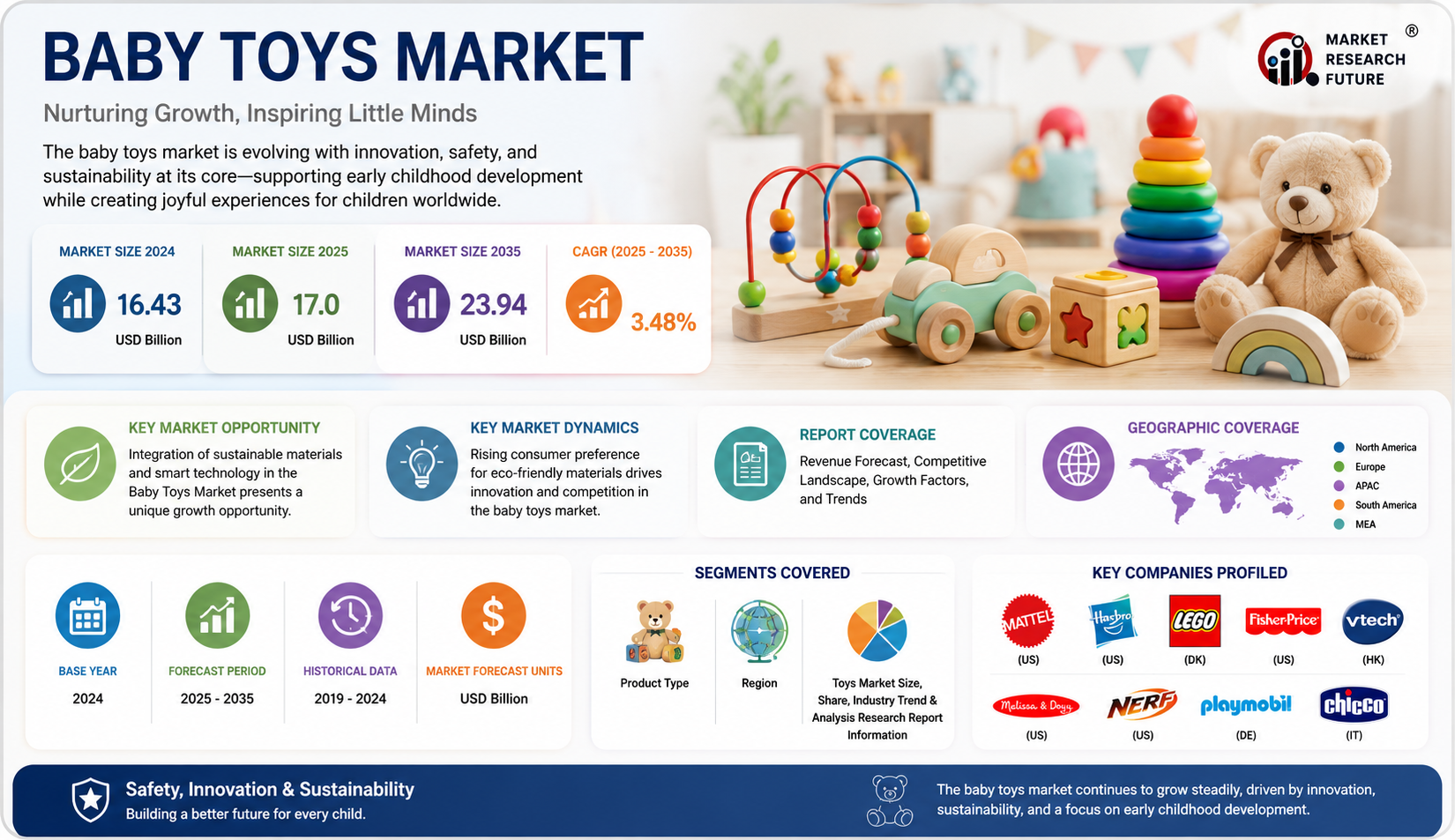
The Baby Toys Market is projected to reach USD 23.94 billion by 2035, driven by demand for educational, sustainable, safe, and technology-enabled toys.
NEW YORK, NY, UNITED STATES, August 26, 2026 /EINPresswire.com/ —
The global Baby Toys Market is undergoing steady transformation as parents increasingly view toys as tools for early learning, sensory development, motor-skill development, and interactive engagement rather than simply sources of entertainment. The market was valued at USD 16.43 billion in 2024 and is estimated to reach USD 17.00 billion in 2025. It is projected to expand to USD 23.94 billion by 2035, representing a 3.48% CAGR from 2025 to 2035. The study covers the historical period from 2019 to 2024 and the forecast period from 2025 to 2035.
Growth is being supported by changing parental purchasing priorities, increasing awareness of developmental milestones, expansion of organized retail and e-commerce, and the introduction of toys incorporating music, lights, motion, tactile elements, and interactive learning features. At the same time, sustainability is becoming a more important product-development consideration, encouraging manufacturers to explore recycled, renewable, wood-based, and other lower-impact materials.
Competitive Landscape and Key Players
The competitive landscape is characterized by established multinational toy companies competing through product innovation, brand recognition, safety standards, licensing, educational functionality, and distribution reach. Major companies profiled in the market include Mattel (US), Hasbro (US), LEGO (Denmark), Fisher-Price (US), VTech (Hong Kong), Melissa & Doug (US), Nerf (US), Playmobil (Germany), and Chicco (Italy). Competition increasingly extends beyond conventional product design toward sustainable materials, connected experiences, developmental benefits, packaging improvements, and products that can remain relevant as children progress through different developmental stages.
Free Sample Copy — Access A Complimentary Copy of Our Report to Explore Its Content and Insights
https://www.marketresearchfuture.com/sample_request/1559
Key Growth Drivers in the Baby Toys Market
One of the strongest growth drivers is the rising emphasis on early childhood development. Parents and caregivers are increasingly seeking toys that encourage cognitive, physical, social, and sensory development. Rattles, stacking toys, activity centers, musical toys, shape sorters, soft toys, and interactive learning products can support hand-eye coordination, recognition, problem-solving, communication, and independent exploration.
The growing preference for educational toys is also influencing product innovation. Manufacturers are combining traditional play patterns with age-appropriate learning objectives, creating products that introduce numbers, colors, sounds, vocabulary, shapes, and basic reasoning. This trend has created opportunities for electronic and interactive products while maintaining demand for simple, screen-free toys.
Another important factor is the expansion of online retail and digital purchasing. E-commerce allows parents to compare products, read reviews, evaluate safety information, and access a wider variety of domestic and international brands. Social media and parenting communities also influence product discovery, although safety, age suitability, material quality, and brand credibility remain important purchasing considerations.
Product Type Analysis
The product type segment encompasses a broad range of baby toys, including sensory toys, activity toys, educational toys, plush and soft toys, musical products, rattles, teethers, construction-oriented products, and electronic or interactive toys.
Sensory and developmental toys remain important because they are designed around fundamental stages of infant development. Products featuring contrasting colors, different textures, sounds, and movement can encourage sensory exploration and coordination.
Educational and learning toys represent another significant area of opportunity. Their appeal comes from combining entertainment with structured learning outcomes. Parents increasingly look for products that can provide developmental value without relying exclusively on digital screens.
Electronic and interactive toys are also gaining attention as technology becomes integrated into children’s products. Voice responses, motion activation, light effects, music, and interactive buttons can create more engaging experiences. However, manufacturers must balance technological features with simplicity, age appropriateness, privacy considerations, battery safety, and parental expectations.
Traditional toys, including wooden toys, stacking products, soft toys, and activity-based products, continue to have relevance because of their durability, tactile characteristics, and limited dependence on electronic components.
Sustainability as a Market Opportunity
Sustainability is emerging as a key competitive factor. Parents are becoming more conscious of plastic consumption, packaging waste, material sourcing, and product longevity. This is encouraging manufacturers to investigate recycled plastics, FSC-certified materials, bio-based materials, responsibly sourced wood, recyclable packaging, and circular product-design approaches.
For example, Mattel states that it is working toward using recycled, recyclable, or bio-based plastic materials across its products and packaging by 2030. VTech similarly highlights sustainable materials and packaging initiatives, including the use of post-consumer recycled PET and FSC-certified materials.
The opportunity is therefore not limited to replacing materials. Companies can differentiate through longer-lasting products, reduced packaging, repairability, responsible sourcing, and clearer recycling information.
Regional Analysis
The market is analyzed across North America, Europe, Asia-Pacific (APAC), South America, and the Middle East & Africa (MEA).
North America benefits from strong consumer awareness, established toy brands, developed retail infrastructure, and high demand for educational and interactive products. Product safety and parental purchasing preferences strongly influence innovation.
Europe is shaped by sustainability, product quality, and stringent safety requirements. New EU toy safety rules adopted in 2025 strengthen requirements concerning hazardous chemicals and introduce digital product passport provisions, reinforcing the importance of compliance and traceability.
Asia-Pacific represents an important growth region because of its large population base, expanding middle-class consumer groups, rising disposable incomes, and growing interest in educational products. The region is also important for toy manufacturing and supply-chain development.
South America presents opportunities through increasing retail accessibility, urbanization, and demand for affordable developmental products. Meanwhile, the Middle East & Africa are supported by expanding modern retail, improving e-commerce penetration, and rising consumer interest in branded children’s products.
Proceed To Buy — Move Forward with Your Purchase and Gain Instant Access to the Complete Report
https://www.marketresearchfuture.com/checkout?currency=one_user-USD&report_id=1559
Industry Development
Expansion of Interactive Learning Toys
Technology-enabled learning is becoming increasingly integrated into early-childhood products. VTech’s 2026 product launches included interactive and sensory-rich toys designed around early learning, discovery, music, movement, and imaginative play. Its FY2026 results also highlighted continued demand for infant, toddler, and preschool electronic learning products, despite regional market pressures.
This development illustrates how manufacturers are moving toward toys that combine physical interaction with responsive technology. Future products may increasingly emphasize adaptive play, motion-based learning, audio interaction, and multi-stage developmental use.
Stronger Focus on Toy Safety and Compliance
Safety and regulatory compliance are becoming increasingly important areas of industry development. In India, BIS organized stakeholder discussions in April 2026 around IS 9873 (Part 1):2025, focusing on mechanical and physical safety requirements for toys. India also updated its toy safety certification framework in 2026, including classifications for non-electric and electric toys and expanded testing requirements.
These developments can influence product design, testing, documentation, sourcing, and quality-control processes. For baby toys in particular, manufacturers must pay close attention to small parts, materials, edges, electrical components, durability, chemical composition, and age-specific safety requirements.
Key Market Dynamics and Future Outlook
The Baby Toys Market is expected to maintain moderate growth through 2035 as manufacturers respond to changing consumer expectations. The combination of developmental play, sustainability, safety, personalization, and interactive technology is likely to shape future product strategies.
The market’s USD 23.94 billion forecast value by 2035 reflects an industry where growth is increasingly connected to product functionality and consumer trust rather than volume alone. Companies that can combine safe design, meaningful developmental benefits, responsible materials, attractive pricing, and convenient distribution may be better positioned to compete.
Frequently Asked Questions
1. What is the projected size of the Baby Toys Market by 2035?
The Baby Toys Market is projected to reach USD 23.94 billion by 2035, expanding at a 3.48% CAGR from 2025 to 2035.
2. What are the major opportunities in the Baby Toys Market?
Major opportunities include the integration of sustainable materials, smart technology, educational functionality, interactive features, and developmental play concepts into baby toy products.
Conclusion
The Baby Toys Market is moving toward a more development-focused, technology-aware, and sustainability-conscious model. From traditional sensory and educational products to interactive learning systems, manufacturers are expanding product capabilities while responding to heightened expectations around safety and environmental responsibility. With the market expected to grow from USD 17.00 billion in 2025 to USD 23.94 billion by 2035, innovation in materials, functionality, safety, and user experience will remain central to competitive positioning.
Read Our Related Research Report
Toys Market –
https://www.marketresearchfuture.com/reports/toys-market-8001
Plush Toy Market –
https://www.marketresearchfuture.com/reports/plush-toy-market-24518
India Toys Market –
https://www.marketresearchfuture.com/reports/india-toys-market-21787
Wooden Toy Market –
https://www.marketresearchfuture.com/reports/wooden-toy-market-34587
Fabric Toy Market –
https://www.marketresearchfuture.com/reports/fabric-toy-market-33270
Sagar Kadam
Market Research Future
+1 628-258-0071
email us here
Legal Disclaimer:
EIN Presswire provides this news content “as is” without warranty of any kind. We do not accept any responsibility or liability
for the accuracy, content, images, videos, licenses, completeness, legality, or reliability of the information contained in this
article. If you have any complaints or copyright issues related to this article, kindly contact the author above.

Media gallery